
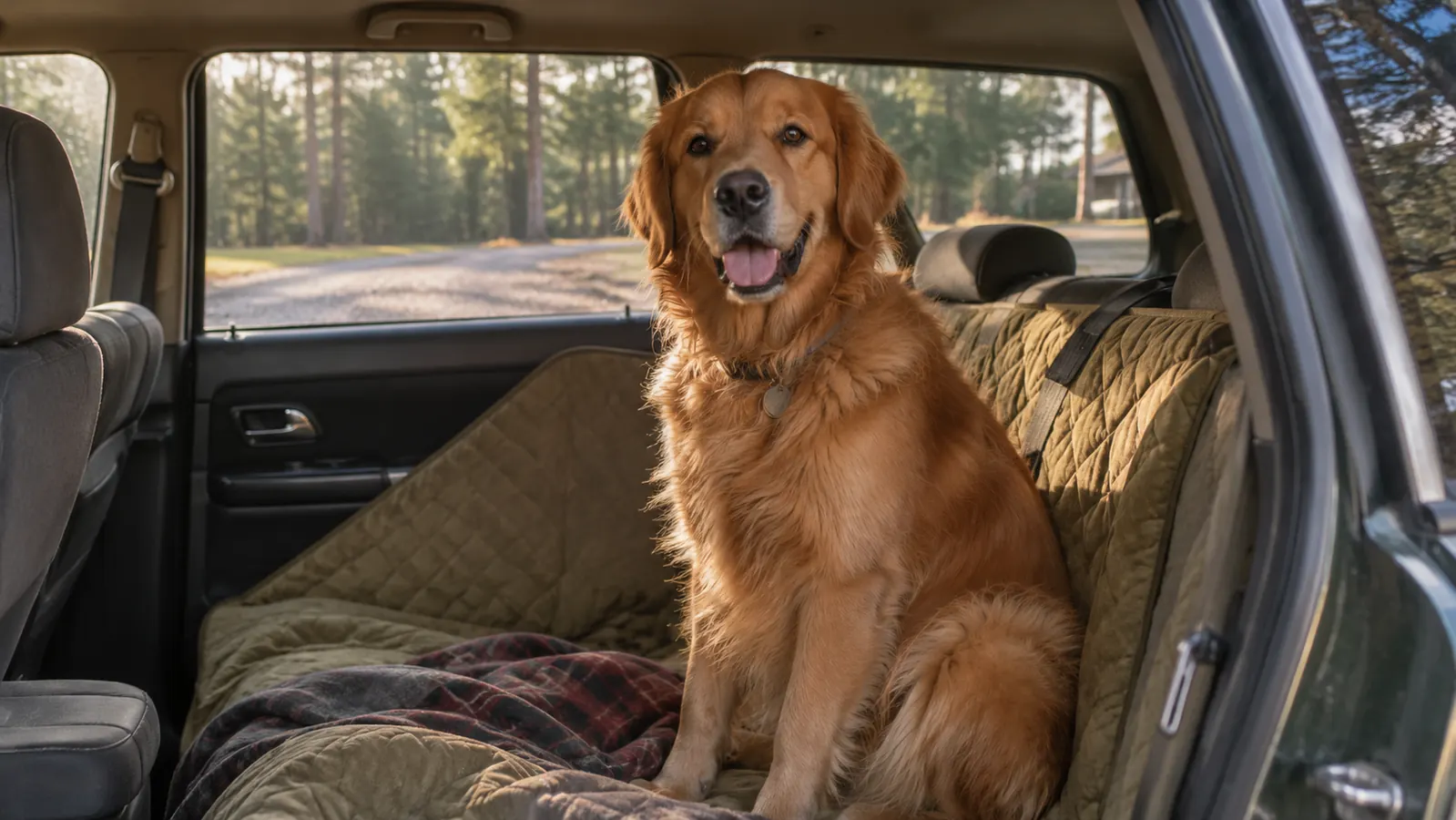
Pepper has one move in the car and she commits to it. Somewhere around mile forty on the drive to Birmingham, she stands up, plants her front feet against the back of my seat, and starts over the console like it is a suggestion instead of a barrier. She is a 6-year-old Australian Shepherd mix, 42 pounds, and the console is exactly the height she can clear. I am 63 and my hands are on the wheel at 70 miles an hour, which is not the moment to be pushing a dog backward with my elbow.
I tried the cheap fixes first. A blanket piled on the console. A cooler wedged between the seats. A stern talking-to, which accomplished nothing except making her pant harder. What finally worked was not a bigger barrier. It was a shorter leash. About four years ago I bought the IOKHEIRA dog seatbelt, a single adjustable tether with a carabiner on one end and a seat belt buckle on the other, and I have clipped it into the same rear buckle on every trip since. It is not a crash-tested harness and I have never pretended otherwise. It is a tether, and a tether set to the right length is what stops the climbing.
In 20 inches of tether, the console stops being reachable
The IOKHEIRA clips to the harness she already wears and clicks into the rear seat belt buckle. It adjusts from 19.6 to 31.5 inches, and short is the setting doing the work.
Amazon Check Today's Price on Amazon →Here is the whole method in the order I would do it again. Five steps, one afternoon of fiddling, and then nothing but habit for the next four years.
Step 1: Attach to the Harness She Already Wears, Never to Her Collar
This is the step people skip and it is the only one that matters for safety. A tether puts load on whatever it is attached to. On a collar, that load goes across the front of the throat. On Pepper, that meant a wet cough and a dog who fought the tether for the next hundred miles. On a harness, the load lands across the chest and shoulders, where her body is built to carry it.
Any well-fitting walking harness with a metal D-ring on the back will do. Pepper wears the same one for walks and for car rides, which keeps things simple. I check it before every trip: two fingers should slide under the chest strap, and the D-ring should sit flat on her back rather than off to one side. If the harness twists when she pulls, it is too loose, and a loose harness is one she can back out of. I learned that in a parking lot outside Collins in the fall of 2022. I had let the chest strap out a notch in July because she was shedding and never took it back in. Halfway up Highway 49 the tether went slack and Pepper was up on the console with the harness still attached behind her. Nobody was hurt. I took that notch back in at a gas station with the engine off, and I have run the two-finger check before every drive since.
Then test the connection standing still in the driveway. Clip the carabiner to the D-ring, not to the leash loop and not to a plastic adjustment slider, and give it a real pull. The IOKHEIRA carabiner is aviation aluminum and it turns on its own pivot, so it does not bind up when she spins around back there. I still tug it every single time before I start the car, because a carabiner that is not fully closed looks exactly like one that is.
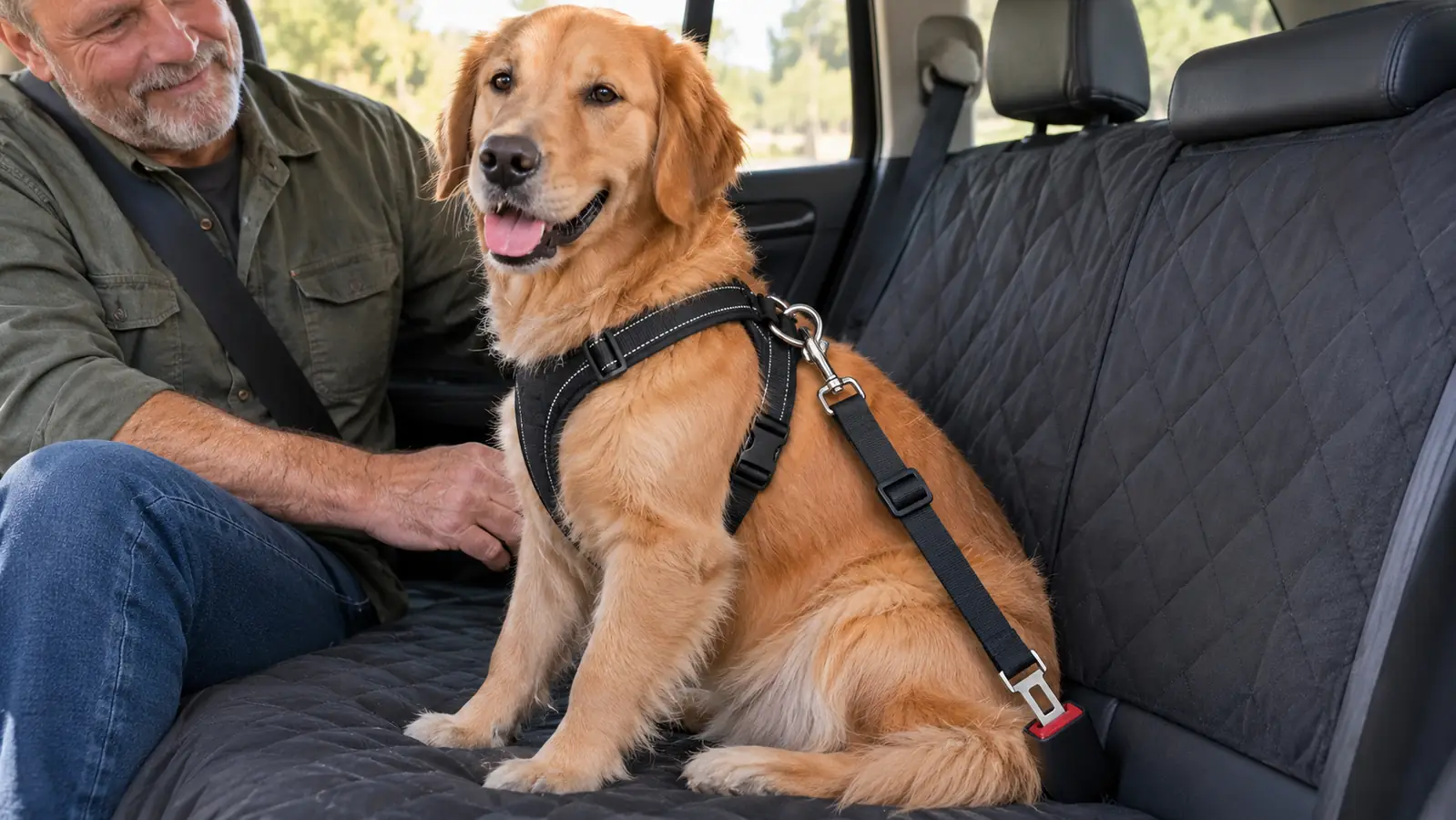
Step 2: Click It Into the Rear Buckle Behind Her, Not the Empty Side
The IOKHEIRA comes with two different buckle styles on the buckle end, so it fits either receptacle shape in a back seat. Find the buckle behind the seat she actually rides in. Pepper rides on the passenger side rear, so that is the buckle I use. Using the buckle behind the empty seat pulls her sideways across the bench and defeats the entire point. In the Outback the rear receptacles sit low, down in the seam between the cushion and the seat back, and with the hammock in place I find the passenger side one by feel. The first winter I had the hammock in, I clipped into the driver side buckle by mistake on a run to the grocery store and watched Pepper lean against the strap the whole way, half turned toward the middle of the bench. That is exactly what a wrong anchor looks like.
Push until you hear the click, then pull the strap to check it. I half-seated mine exactly one time, and it held, and it held purely by luck. Luck is not a system.
Do not loop anything around a headrest post. In the early days I used a different strap over the headrest, and it slid, the loop loosened, and by the time we crossed into Alabama she had enough slack to reach the console anyway. A headrest post is a fine place to hang a hammock strap. It is not an anchor for a dog.
Step 3: Set the Length Short, and Measure It With Her Standing
The tether slides from 19.6 inches to 31.5 inches on the metal hardware. I run mine at the short end, right around twenty inches, and that number is what makes the whole thing work.
Here is how I set it. Pepper goes on the seat, standing. I shorten the strap until she can sit, lie down and turn around without the tether pulling tight. Then I try to walk her toward the console with my hand flat against her chest. If her front paws can reach the console lid, it comes up another inch. If she cannot lie down without her head being propped up, it goes back out. It is a two-inch window and it takes about five minutes to find. I do it in the driveway on a Saturday morning, before the car has moved, with the rear door open and Ray standing there with a cup of coffee offering opinions. The last reset was this past September, after Pepper put on a couple of pounds over a soft summer. One click at a time until she could lie flat with her chin on the seat and still not get a paw past the front edge.
One thing I got wrong at first: the bungee section stretches. If you measure while the bungee is already pulled out, you will set the tether long, and she will find those extra inches somewhere around Tuscaloosa. Pull the bungee out to judge the true length, then let it settle back before you decide.
And adjust it parked. My rule is that a wrong length gets fixed at the next rest stop, never with one hand while the other one is on the wheel.
She can sit. She can lie down. She can turn around. What she cannot do is put a paw on the console, and that is the whole job.
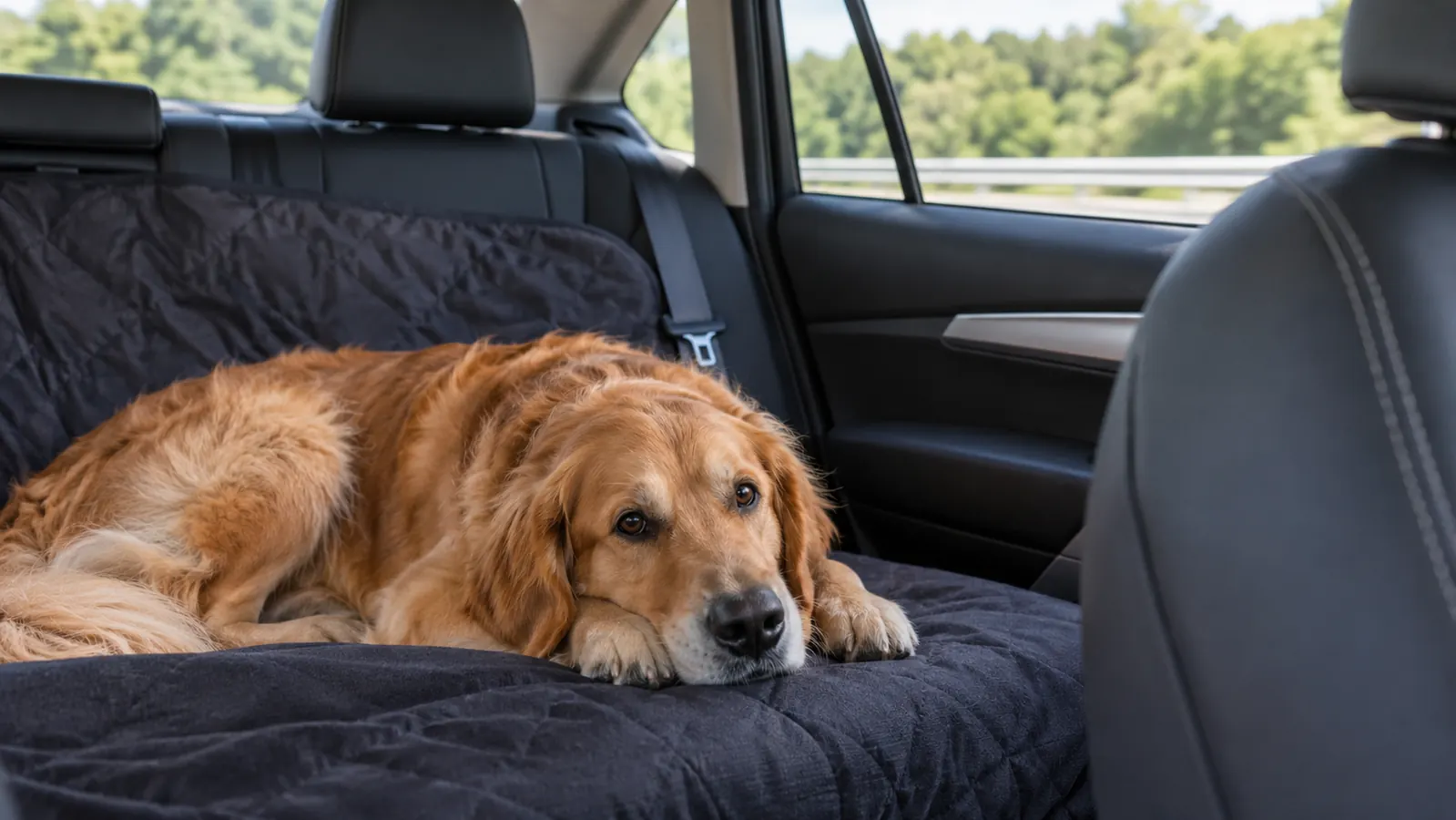
Step 4: Give Her a Reason to Want to Stay Back There
A tether stops the climb. It does not make the back seat a place she wants to be, and a dog who is miserable back there will spend the whole drive testing the tether. So I made the back seat better than the front seat.
The first fix was the floor. A dog climbing forward is often a dog avoiding a hole. The Active Pets hammock has been in the Outback for a little over four years, hooked over both rear headrests and the front ones, so the footwell is fabric instead of a gap. That alone took the frantic edge off her.
Then the familiar things. A blanket that smells like the house, folded on the seat beside her. A window cracked two fingers on her side, which she uses like a television. And timing. We leave after her morning walk, not before it, because a tired dog lies down on her own. I also keep water stops quick and boring, since a big production at a rest area winds her up for the next fifty miles.
The panting has eased over four years but it has never gone away. She still pants through the first half hour of any drive and then settles. I stopped expecting gear to fix that. What the gear does is keep her in the seat while she works through it.
Step 5: Test It on Short Drives Before the Four-Hour One
The first drive with the tether was ten minutes of errands around Hattiesburg. The second was thirty minutes out and back on a two-lane. The Birmingham run came third, and I am glad it did. Pepper is smart and she solves problems, and ten minutes is long enough for her to try spinning, lying down backward, and working the strap up over her own back. That first ten minutes was a Tuesday, the loop past the feed store and back, and she tried three things in that short a time. She spun to the left, she lay down facing backward, and she pushed her shoulder against the strap to see if it would give. It did not give, and by the time I pulled back into the driveway she was sitting down.
What I watch for on a test drive: whether the tether crosses her legs when she turns, whether she can get a front paw onto the console, and whether she settles after the first twenty minutes or fights it the whole way. Two of the three were fine on the first attempt. The paw on the console came back, so I took an inch out of the length, and it stopped.
If you have a second person for the first test, put them in the back seat and nobody behind the wheel. If you do not, pull over to adjust. There is no version of this where reaching back at highway speed is a good idea, and I say that as a woman who has done it and gotten away with it.
What Else Helps
The tether is the piece that stops the climbing. Everything below is what makes the rest of the trip go smoother.
Water at every stop. The SLSON collapsible bowls live in the car, one clipped to Pepper's leash and one in the glovebox, and I fill them from a jug I keep behind the seat. A dog who drinks at a rest area settles faster afterward. The jug is a plain half-gallon refillable I fill at the kitchen tap before we leave, and it lasts the whole four hours with some to spare. On the longer Smoky Mountains runs I top it up at a rest area instead of carrying more weight around. I do not feed her a real meal within two hours of leaving, because a full stomach on a winding road is a separate problem I would rather not manage.
The packing happens the night before. The PetAmi travel bag gets her food in the containers it came with, her medicine, the brush, the waste bags and a spare leash. Nothing loose on the back seat. Loose gear is something to climb over, and I have watched her try.
Small comfort items pull more weight than people expect. A sunshade on the rear glass in summer, a blanket over the seat in winter. A dog who is baking or shivering has restless energy, and restless energy is what sends her forward in the first place.
Two Mistakes That Cost Me Time
The first was the collar. I clipped a tether to it once, on a short drive to the vet, and she coughed at every stop sign. That was the last time. If you take one thing from this whole page, take that one.
The second was setting the tether long because I felt guilty. I gave her about thirty inches so she could stand up properly, and then I spent two trips reaching back to push her out of the passenger footwell. The tether was working perfectly. It was simply working as a longer leash. Shorten it and the same piece of gear does the job it was bought for.
Four years, one tether, and the console is finally just a console
The IOKHEIRA dog seatbelt clips to a back harness and clicks into the rear buckle, adjusts from 19.6 to 31.5 inches, and lives in the Outback between trips. Set it short, test it on a ten-minute drive, and the four-hour one takes care of itself.
Amazon Check Today's Price on Amazon →