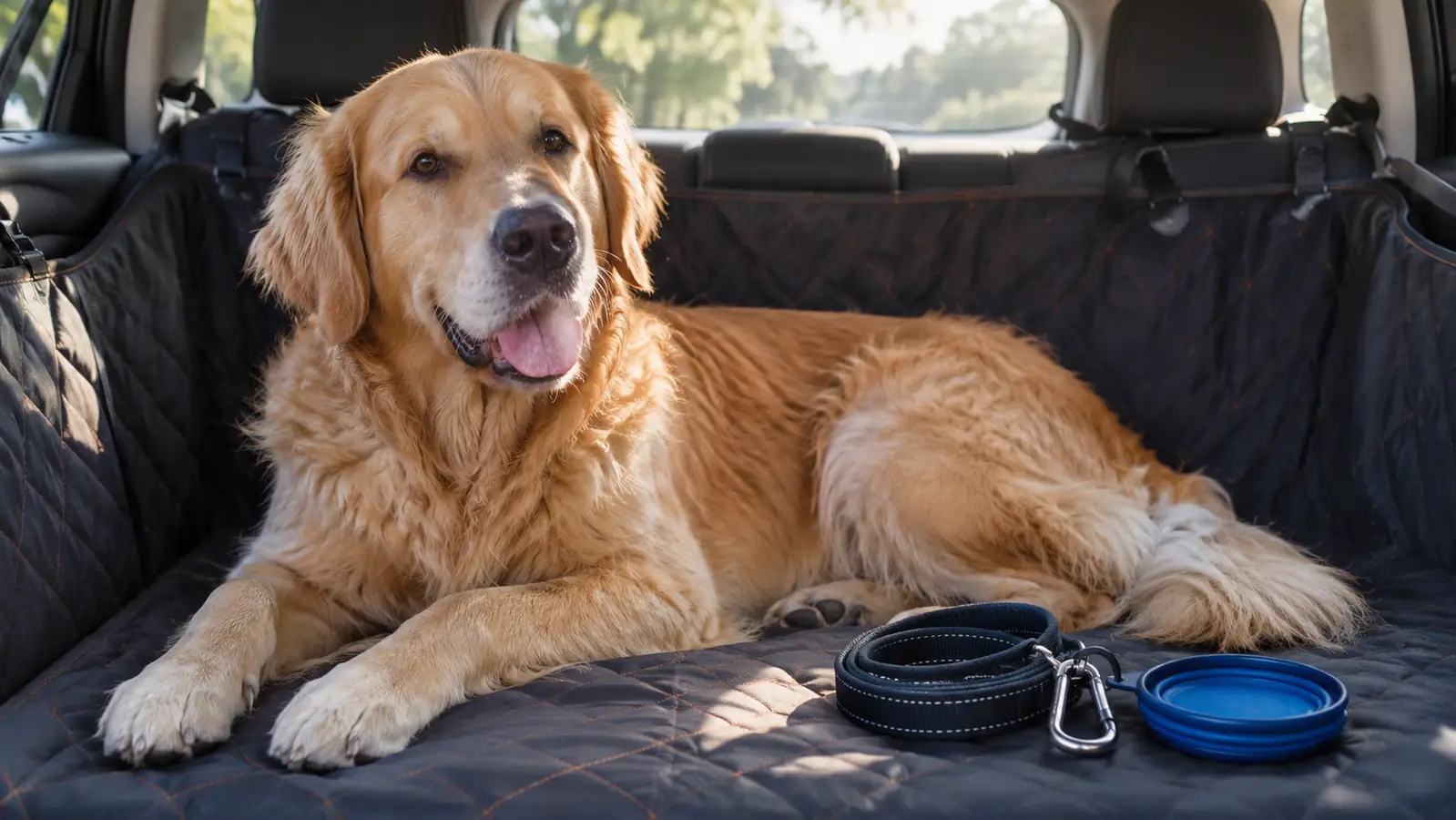
The first time I drove Pepper up to Birmingham, I forgot to bring water. Four hours on I-59 with a two-year-old Australian Shepherd mix panting in the back seat and nothing for her at the rest stop outside Meridian but an empty coffee cup lid I filled at the sink. She knocked it over twice and then looked at me like I had failed her personally. I have not made that mistake again. What fixed it was a two-pack of SLSON collapsible bowls, one clipped to Pepper's leash and one living in the glovebox of the Outback, and they have been in the car for about three and a half years now.
I am not a gear reviewer. I taught middle school PE for 31 years, I am 63, and my credentials here are roughly 40 round trips between Hattiesburg and Birmingham, a couple of longer runs to the Smoky Mountains and the Gulf coast, and one dog who will try to climb into the front seat if you give her an inch. But I do know what holds up and what quietly falls apart in a hot car over a few years, and I have opinions about both. So here is what three and a half years of actual use looks like, including the parts I do not love.
The Quick Verdict
Folds flat to half an inch, holds 12 fluid ounces, and has spent three and a half years clipped to a leash in a Mississippi car. The carabiner is the weak point, not the bowl.
Amazon Check Today's Price →The bowl that lives in my glovebox instead of a kitchen drawer
Two bowls, two carabiners, 12 fluid ounces each. Folded flat to half an inch so it fits in the space where the coffee cup lid used to go.
Amazon Check Today's Price on Amazon →How I've Used It
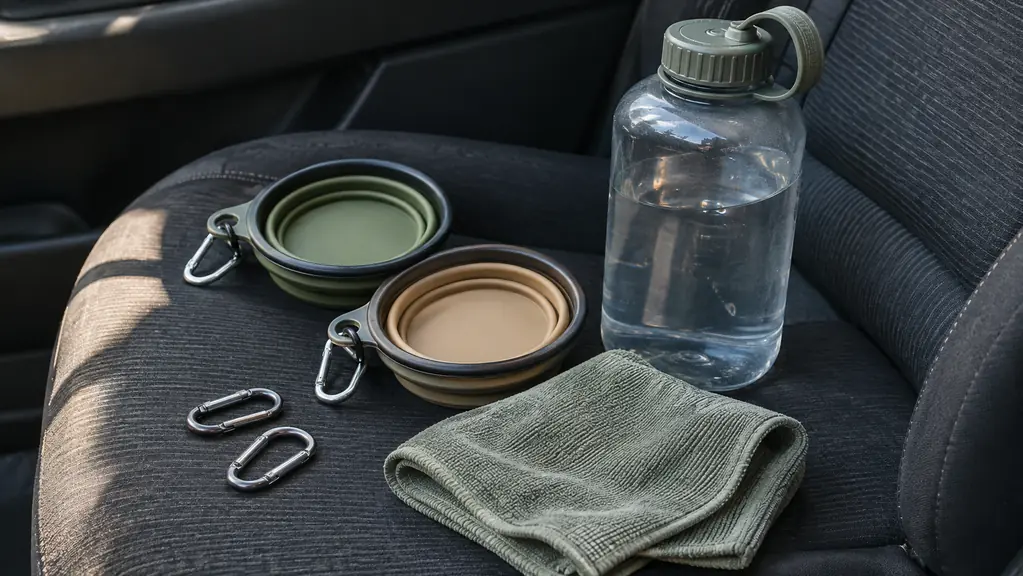
The two bowls split jobs the week I got them. One rides clipped to Pepper's leash with its carabiner, so it is in my hand the second we stop. The other sits in the glovebox next to the registration and a roll of waste bags, and it comes out when the leash bowl is wet, misplaced, or drying on the kitchen counter. I keep a half-gallon jug of water on the floor behind the passenger seat. The bowls are only bowls. They do not store water and they are not a bottle, and that distinction matters more than it sounds like it should when you are standing in a parking lot at 90 degrees.
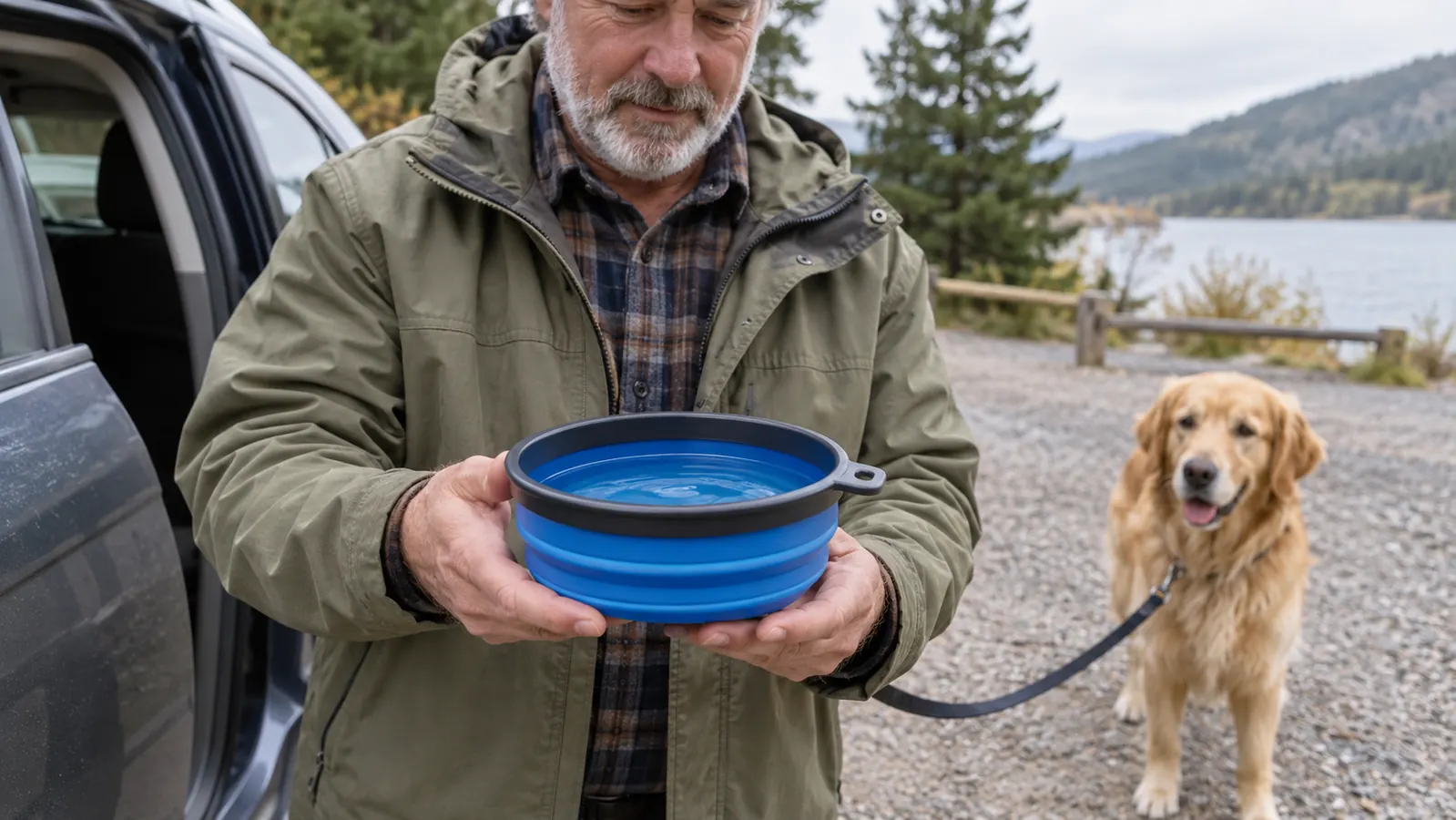
The routine at a rest stop takes about ninety seconds. I open the door, hook Pepper's leash to my wrist, unclip the bowl, pull the rim until it opens, pour from the jug, and set it down in the shade of the car. She drinks, usually too fast, and then I dump what is left, wipe the bowl with a rag I keep in the door pocket, and press it back flat. At 12 fluid ounces it is one solid drink for a 42-pound dog. On a hot July drive I will do that twice per stop and top off the jug once before we get back on the interstate.
One thing I want to be clear about, because I have confused myself on it more than once. The bowls in the PetAmi travel bag are not these. The PetAmi came with its own two little bowls and those live in the bag for meals at the hotel or at my daughter's house. The SLSON pair is the road water. If you are packing for a trip, that split is worth keeping, because the bag bowls never leave the bag and the road bowls never come inside.
There is a second use I did not expect. On the long runs, I will put about a cup and a half of Pepper's kibble in the glovebox bowl at the halfway point and let her eat standing in the grass before we finish the drive. The listing says 1.5 cups of food, and that is accurate. It fills the bowl to a sensible level without spilling over the rim when she noses at it. It means we arrive with a dog who has both eaten and drunk, instead of a dog who has done neither and is out of sorts for the rest of the evening.
My one early mistake was clipping the bowl to the handle loop of the leash instead of the D-ring at the collar end. It banged against my knee for a whole trip. On the D-ring it hangs still and flat, and Pepper does not even turn her head when I unclip it. Small thing, but it took me a year to figure out, so I am passing it along.
What You Actually Get, in Plain Numbers
The SLSON listing says 2 pack, and it means two bowls, each holding 12 fluid ounces of water or about 1.5 cups of food. Expanded, each bowl measures 5.1 by 3.5 by 2.1 inches. Collapsed, it sits at half an inch tall, which is the entire reason this works in a glovebox. Fully folded it weighs 3.53 ounces, so clipped to a leash it is not something Pepper notices or drags around. The material is a soft plastic, odorless out of the package, and the operation is manual from start to finish. There is no mechanism to jam, because there is no mechanism.
The two carabiners ship with it and they are the part that turns a bowl into car gear. Clip one to a leash D-ring, a belt loop, a backpack strap, or the handle of a tote, and the bowl hangs flat against whatever it is clipped to. The listing also notes a two-year warranty, which is longer than I would have guessed for a bowl this simple, and I will say plainly that I have never had to use it.
People ask me why bother with two. The answer is that the second one is not a spare, it is the one that makes the first one convenient. If you only own one, you will leave it in the kitchen sink to dry and drive off without it, which is exactly how I ended up with a coffee cup lid in the first place. Having one that never leaves the car solved the forgetting problem, not the bowl problem.
What Three and a Half Years Did to Them
Here is the honest part. The bowls have held up better than I expected. The plastic at the fold lines still creases cleanly, no cracks, no white stress marks, and neither bowl has started leaking at the seams, which is what I assumed would go first. They have been left in a closed car through four Mississippi summers, and they have not gone brittle or taken on a smell. I rinse them in the sink maybe once a week during travel season and let them air dry open on the counter.
The carabiners are a different story. Both are thin wire-gate clips, and after three and a half years of hanging off a leash, one of them has lost most of its spring. It still clips, but it does not snap shut on its own anymore, so I check it before I trust it. The other is fine. If the clip is the part you care most about, plan on replacing them eventually with something sturdier from a hardware store. The bowl will outlast the hardware it came with, and I think that is just the deal at this size.
One thing I watch for with anything that folds is whether it starts to go floppy, and these have not. The rim still holds its shape when it is open, and the bowl sits flat on the ground instead of rocking. The plastic has softened slightly at the creases, which I would expect after this long, but it has not thinned to the point where I am worried about a hole opening up. If a fold ever does split, the warranty is there and the failure would be obvious the first time I poured water in.
The other thing, and this is not a defect so much as a fact of life: a soft plastic bowl on the ground at a rest area is light. Pepper has put a paw in it and tipped it more than once, and on a windy afternoon at a roadside table I chased one across the pavement. I now set it in the shadow of the tire or hold the rim while she drinks. A heavier bowl does not have this problem, but a heavier bowl also does not fold to half an inch and live in a glovebox for three years.
What I Liked
- Folds to half an inch, so the second bowl genuinely lives in the car instead of a drawer at home
- 12 fluid ounces per bowl and about 1.5 cups of food, enough for one proper drink for a 42 pound dog
- The two included carabiners clip to a leash, a belt loop or a backpack strap, and the bowl hangs flat
- Soft plastic, odorless out of the package, with no mechanism to jam or lose
- Three and a half years in a hot car with no cracks at the fold and no leaks at the seam
- Two bowls in the pack, which sounds like one more than you need until the first one is wet
Where It Falls Short
- The wire-gate carabiners are the weak point. One of mine lost its spring after a few years
- Light enough that a dog paw or a gust of wind tips it over on pavement
- 12 ounces goes fast on a hot day with a panting dog, so you will refill
- Not insulated and not a bottle. It only holds what you pour into it
Four Mississippi summers in a closed car, and neither bowl has cracked at the fold or leaked at the seam. Both carabiners are another matter entirely.
What I Tried Before These
Before the SLSON bowls I tried a folding fabric bowl and a plastic bottle with a trough built into the lid. The fabric bowl was fine until it stayed damp in the car for two days and started to smell like a pond. The bottle was fine until the lid gasket went missing somewhere around Lake Charles and it leaked into my tote bag. Neither was a disaster, and I am not going to pretend they were. But both had a part that could fail or a material that could hold water in a way you do not want. A plain plastic bowl on a carabiner does not have that problem, because there is nothing to lose and nothing to absorb.
What I did not try was a heavy stainless bowl, because the whole point was something that could ride in the car without being noticed. If I were feeding Pepper in the same spot every day, I would use a heavy bowl and never think about it again. On the road, the folded bowl wins on the single fact that it disappears into the glovebox and I never hear it rattle.
Why It Matters With a Dog Like Pepper
Pepper is six now and she is better in the car than she was at two, but she still pants for the first stretch of any drive and she would still rather be in my lap than in the back seat. She rides in the back, tethered to the seat belt with a bungee leash clipped to her walking harness and never to her collar, and she has never once been allowed up front. What the bowl does for her is small and real. At every stop she gets a drink and a few minutes standing in the grass, and she gets back in calmer than she got out. It is not a cure for anything. It is one less thing to be wound up about, for her and for me.
I bring this up because water on the road is not really about convenience. A dog who is panting hard in July and not drinking is a dog you worry about, and I have done the worried version of that drive, and it is a very long four hours. Having the bowl already clipped to the leash means I never talk myself out of stopping because it is a hassle. That is the whole argument for it, and it holds up every single month.
Who This Is For
This is for the person who drives with a dog, keeps meaning to bring water, and keeps forgetting. It is for the glovebox, the leash, the backpack strap, and the tote bag, and for any dog who will drink at a rest stop but turns her nose up at a strange public bowl. If you make a four hour drive once a month with a dog who pants for the first half hour, a bowl clipped to the leash is a small thing that removes a recurring worry. It has been worth it to me for about three and a half years, and I would buy the pair again tomorrow.
Who Should Skip It
If your dog drinks a quart at a stop, 12 ounces per bowl means pouring twice, and a bigger collapsible bowl or a bottle with a built-in trough is a better fit. If you are backpacking for days and counting every ounce, the 3.53 ounce bowl is fine, but the flat-fold design is not meaningfully lighter than a fabric bowl. If what you actually want is a bowl that will not tip on pavement, a soft plastic bowl is not that, no matter whose name is on it. And if you already own a travel bag with bowls sewn into it, check whether you need a second set. I did, because the bag bowls stay in the bag, but not everybody does.
One bowl on the leash, one in the glovebox, no more coffee cup lids
Two collapsible bowls, two carabiners, 12 fluid ounces each, folded flat to half an inch. Three and a half years in my Outback, and I would buy them again.
Amazon Check Today's Price on Amazon →